Clinical registers
Clinical registers are the memory of what happened: a fall, a wound, an episode of infection. Each register follows one theme, for one resident, over time — which is what an inspection, a handover or a family conversation needs.
The seven registers
All under Nursing Care → Care → Registries:
Register |
What it records |
|---|---|
Restraint Registry |
Every restraint measure, its reason, its prescription, its consent and its checks |
Fall Registry |
The fall-risk assessments and the falls |
Continence Registry |
The continence situation and the toileting programme |
Wound Registry |
Wounds, their care and their healing |
Infection Registry |
Infection episodes and the measures taken |
Procedure Registry |
Invasive devices: catheter, venous line, tube, stoma… |
Isolation Registry |
Isolation measures and their follow-up |
A register is not a scale
A register records events. A scale measures a state at a given moment — Braden, MNA, Tinetti, MMSE, the pain scales. They are filled in from the resident’s record or from the care app, and are described under Geriatric assessments.
What every register shares
A state: Active or Closed.
Re-evaluation Every (weeks), with the Next Evaluation and the Last Evaluation. A register due for re-evaluation shows up in the list’s filter and in the multidisciplinary meeting.
An Evaluations tab: each re-evaluation records what was seen and the Decision taken.
Close when the situation is over; Reopen (head nurse) if it comes back.
Add to the care plan (restraint, fall, wound): turns what the register observed into a proposed care; you decide. Care Lines shows the care that came from it.
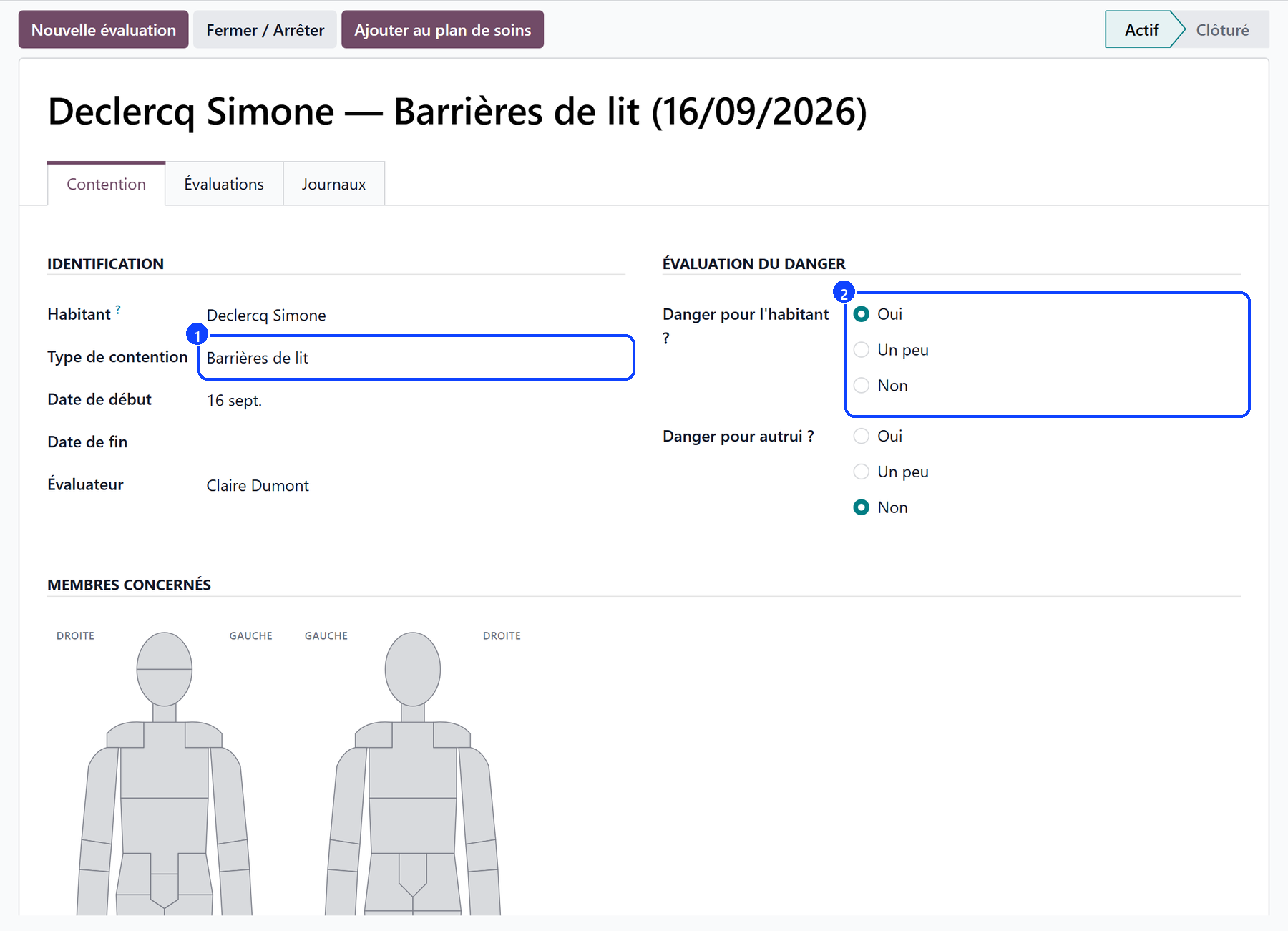
Restraint
Pick the Restraint Type: Bed Rails, Pelvic Belt, Wheelchair Tray, Wrist Restraint, Vest Restraint, Probe / Staple, Chemical Restraint (Medication), Other.
Write the reasons and the Danger Assessment, the Limbs concerned and the Alternative Measures tried first.
Record the Medical Prescription (its date and planned duration in days), the Monitoring and the Consent — from the resident, their legal representative or a family member.
The Logs tab notes each placement, removal and check, with the skin and comfort.
New Evaluation re-evaluates the measure: maintain, stop or change the modality. Close / Stop ends it. Where the law requires the physician’s countersignature, Countersign records it. Filters: Active, Needs Re-evaluation, Closed.
Falls
An entry is either a Risk Assessment or a Fall Incident.
Risk assessment — the Morse Fall Scale: history of falling, secondary diagnosis, ambulatory aid, IV or heparin lock, gait, mental status. The score gives Low, Moderate or High Risk.
Fall incident — the hour, the location, the witnesses, the circumstances, the Injury Severity (No Injury, Minor, Moderate, Major), the Injured Zones on a body map, the actions taken, whether the physician and the family were notified, and Photos.
Preventive Measures — environment adapted, walking aid provided, medication reviewed, footwear adapted, lighting improved.
Every fall is read by a head nurse
A fall waits for a head nurse’s reading: a banner says so until a head nurse clicks I have read it. For a serious fall, a banner reminds that the family has not been informed yet: Inform the family prepares the email to the resident’s contact persons.
A fall written as an observation can be opened in the fall register, and a fall creates a record review. Filters: Assessments, Incidents, Active, High Risk, To Read, Read.

Continence
The Type of incontinence, its Frequency (Occasional, Frequent, Permanent) and the Toileting Program. Decisions at re-evaluation: maintain, change the protection, start a toileting programme, refer.
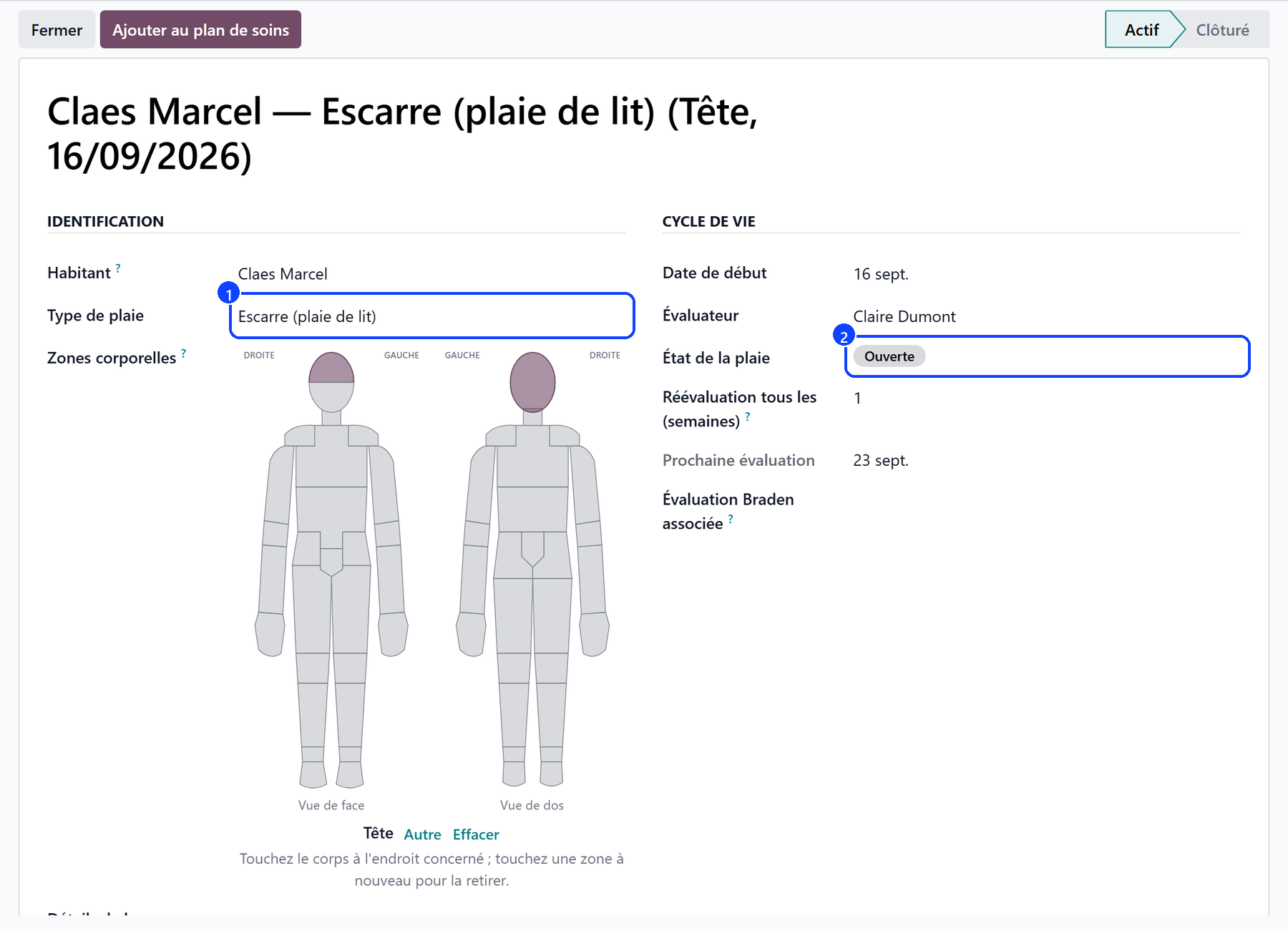
Wounds
The Wound Type, its Location on the body map, the Date of Onset and its Origin, the stage for a pressure ulcer, the exudate, edges and tissue, and the Wound State: Open, Healing, Healed or Reopened (with the Date Healed). Tabs: Initial Assessment, Evaluations, Documents, Notes.
Decisions at re-evaluation: continue the current care, change the dressing protocol, refer to a specialist, escalate, mark healed. Filters: Open, Healing, Healed, Reopened, Pressure Ulcers.
Infections
The site, the origin, a Multi-resistant ribbon, the sample, the Antibiotic Therapy, whether isolation is required and the coordinating physician informed, and the Outcome: Ongoing, Cured, Hospitalised, Deceased. Tabs: Management and Evaluations.
Procedures
The device — Urinary Catheter, Venous Line, Gastrostomy (PEG), Nasogastric Tube, Tracheostomy, Oxygen Therapy, Stoma, Drain, Other — with Replacement Every (days), the Replacement Due date and whether a Medical Prescription is on file. Decisions: maintain, replace, remove, refer.
Isolation
The Precaution Type (Contact, Droplet, Airborne, Protective Isolation), single room, signage at the door, family informed, and whether a physician prescribed it (a warning shows when not). Tabs: Reason and Criteria, Related Infections, Evaluations. Decisions: maintain, downgrade the precautions, lift. Lift Isolation closes it.
What feeds the registers
The WideCare app writes into the registers from the bedside: a fall observation, a wound observation with its photo and its measurements, a continence observation. See Observations.
An observation of a fall or a wound offers Open in the fall register or Open in the wound register.
The multidisciplinary meeting can ask for a new entry (Register a fall, Open a wound register, New restraint…) as a care task to plan.