Granting an access
An access joins one resident and one relative. You open it from either side:
from the resident’s record, Identity tab: on the relative’s line in Contact Persons, click Portal;
from the relative’s contact record, Family tab: on the resident’s line, click Portal;
from Nursing Home → Family Portal → Accesses, with New.
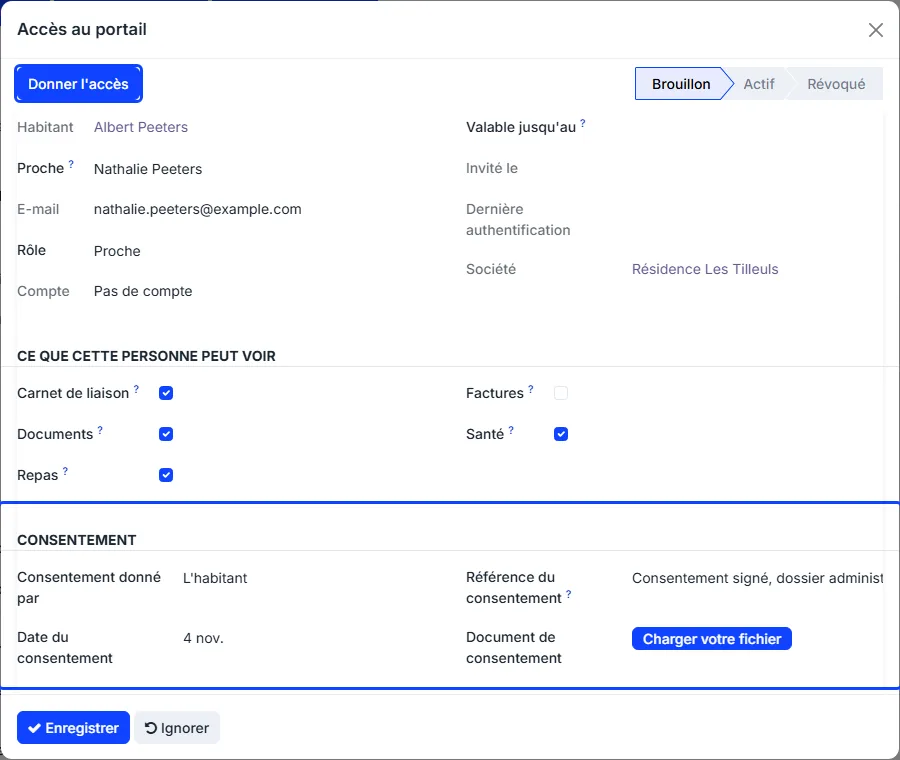
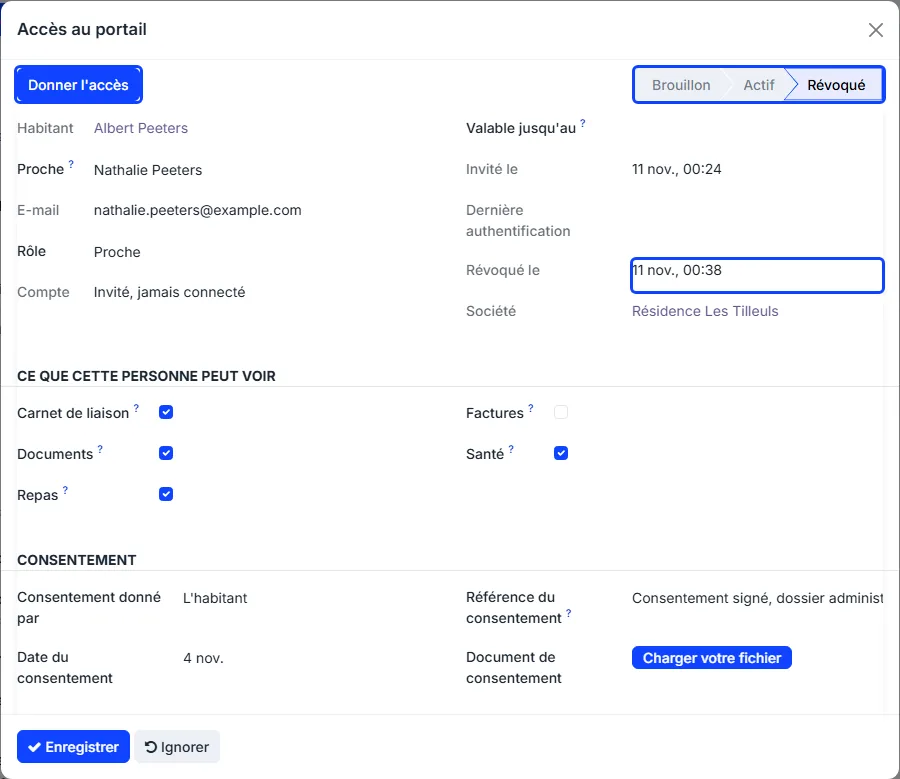
Portal opens the Portal Access dialog of that pair: the existing access, or a new one ready to be granted. The Portal Access column next to it shows where the relative stands: Not invited, Invited, never signed in, Signed in or Revoked.
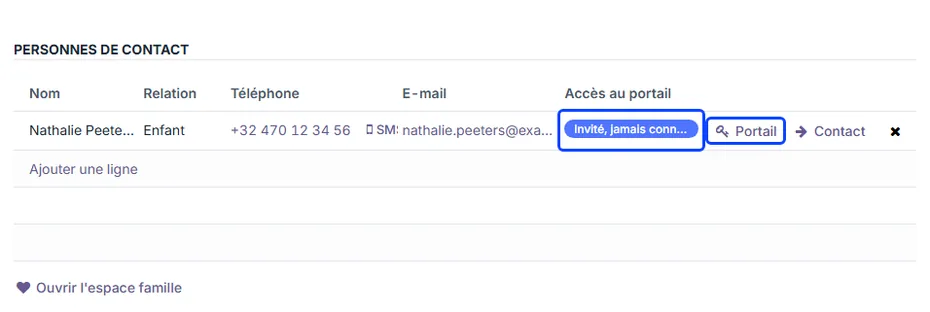
A relative not yet in the list
Add them first as a contact person of the resident (name, relationship, e-mail), save, then click Portal on their line. An access created from the Accesses menu adds the person to the resident’s contact persons by itself.
1. Set who and what
Check the resident (or the family space) and the relative.
Check the E-mail: it becomes the relative’s login.
Set the role: Relative, Trusted Person or Legal Representative.
Tick what this person may see, under What This Person May See: Liaison Notebook, Documents, Meals, Invoices, Health.
Fill in Valid Until if the access is temporary. Left empty, the access lasts until it is revoked.
2. Record the consent, for health data
The Consent group asks for:
Consent Given By — The resident or The legal representative;
Consent Date;
Consent Reference — where the signed consent is filed, or the decision appointing the representative — and, if you have it, the Consent Document.
Consent Given By and Consent Date become required as soon as Health is ticked: without them, WideCare refuses to save.
3. Grant the access
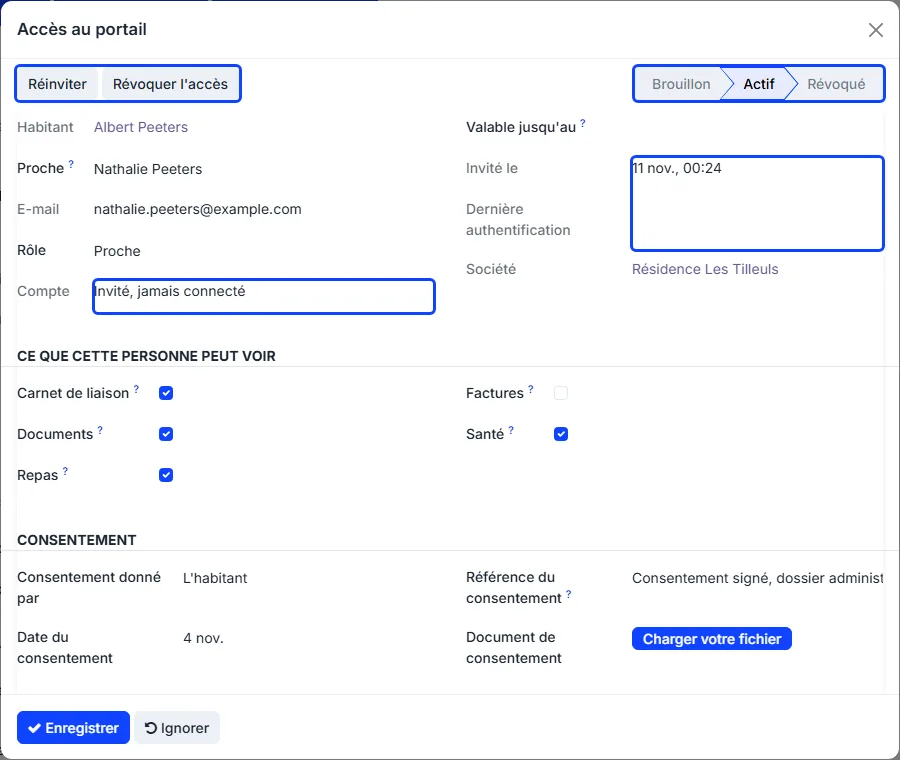
Click Grant Access. WideCare:
creates the relative’s portal account if they have none (login = their e-mail address) — someone who already has a user account keeps it;
sets the access to Active and dates it in Invited On;
subscribes the person to the liaison notebook;
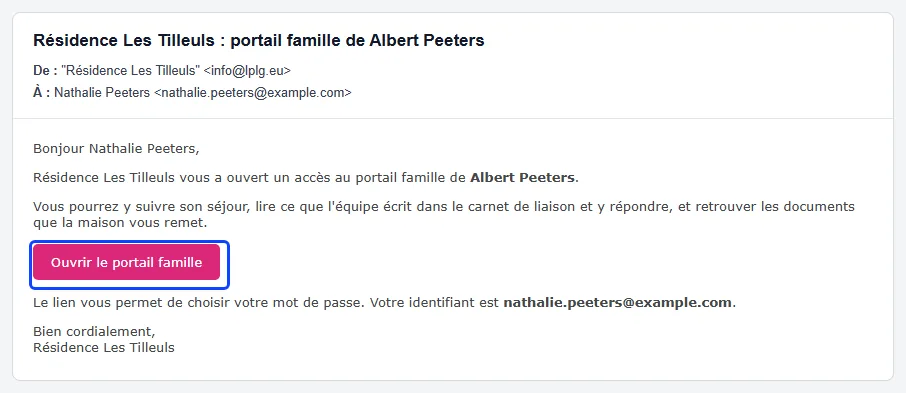
sends the invitation e-mail, with a button to open the family portal and, for a new account, a link to choose a password. When a Valid Until date is set, the e-mail states it.
On an active access, Re-Invite sends the invitation again — useful when the relative lost it or never set their password.
Grant Access is refused when:
the relative has no e-mail address;
the Valid Until date has already passed — extend it first;
the address is already the login of another user.
The access then follows the person: Account reads No account, Invited, never signed in or Signed in, and Latest Authentication gives the date of their last sign-in.
The invitation e-mail
The invitation is an ordinary e-mail template, Family Portal: Invitation. Your administrator can adapt its wording; the Family Portal filter finds it in the list of e-mail templates.
4. Revoke
Revoke Access closes the access, after a confirmation: the person no longer sees anything about the resident, and is unsubscribed from the notebook. The date is kept in Revoked On.
An access whose Valid Until date has passed is revoked automatically the next day.
The account is not deleted
Revoking an access does not disable the person’s account: they may hold accesses to other residents, or receive their own invoices.
Find an access
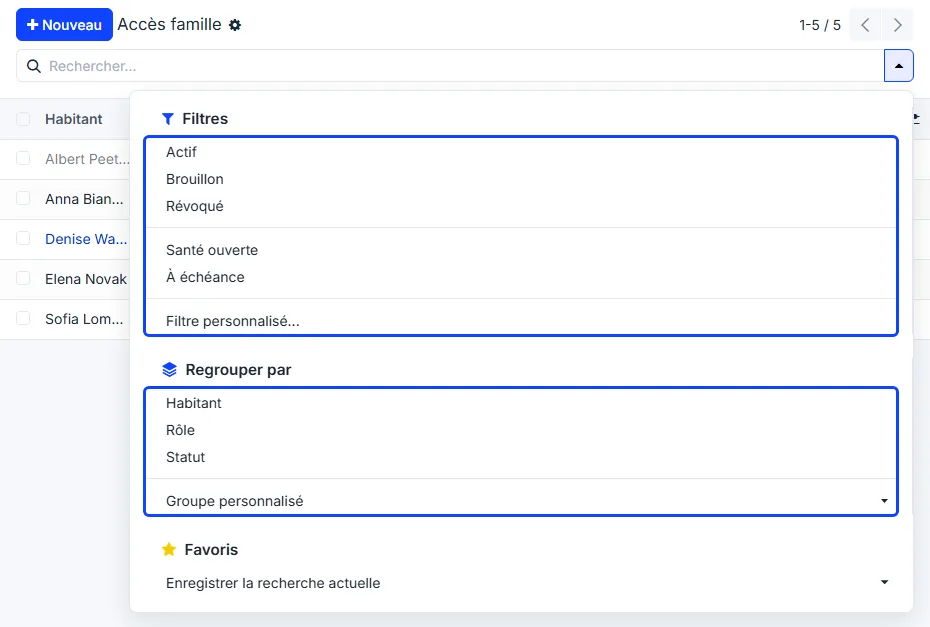
Nursing Home → Family Portal → Accesses opens on the Active accesses. The filters Draft, Revoked, Health Opened and Expiring (an access with a validity date) narrow the list; group it by Resident, Role or Status.
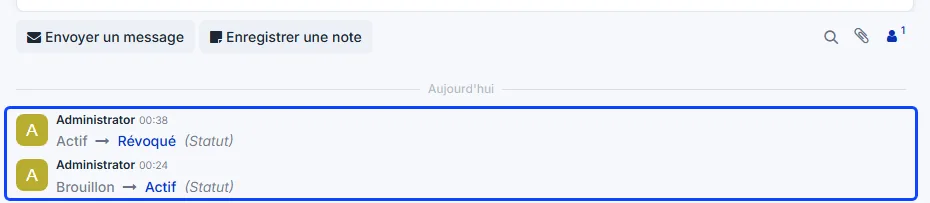
Every change to an access — person, role, scopes, consent, status, validity — is traced in its history.
Who may do what
Every nursing home user reads the accesses.
The administrative staff, managers and directors create, grant, re-invite and revoke them; the Portal button only shows for them.
An access can only be deleted once it is no longer active.
In other words, a nurse can write in the notebook without being able to open an access to anybody.