Care
The care side of WideCare is split into two apps that share the same data:
Nursing Care — the clinical workspace: the dashboard, the resident’s record, observations, assessments, care plans, multidisciplinary meetings, clinical registers, medicines and reports.
Care Tasks — the worklist: the care tasks that the care plans create every day, for the shift to pick up and record.
Both apps are reserved for care staff. On the go, the same work is done from the WideCare app.
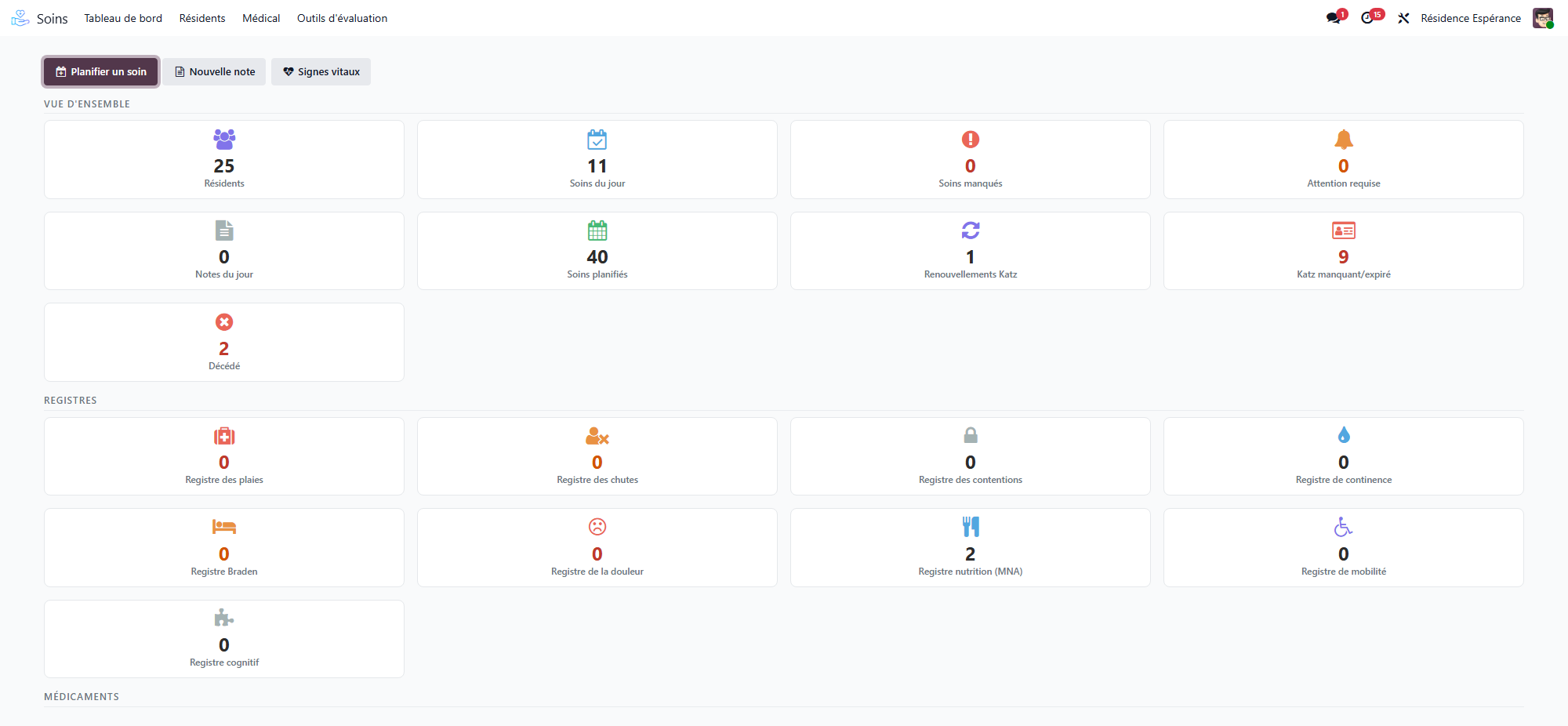
The Nursing Care menus
Dashboard — the care board, see The care dashboard.
Residents — All Residents, Absences (when billing is installed) and Life Projects.
Care — the clinical menu, in four sections:
Observations — Observations, Attention Required, Observations to read, Stools and Urine and Stool and Urine Observations;
Assessments — Evaluations to Validate and Anamneses, plus the country’s dependency assessment;
Plans and Meetings — Care Plans, Objectives, Multidisciplinary Meetings and Reviews in Meeting;
Registries — the seven clinical registers.
Medicines — one entry that opens the Medicines workstation, see Medicines and Prescriptions.
Evaluation Tools — the assessment scales (MMSE, Braden, MNA, OHAT, Tinetti, pain), see Geriatric assessments.
Reports — Record Reviews, Plan Reviews and the other care reports.
Configuration — settings and catalogues, among them Clinical Catalogues (dosages, allergens, pathologies); see Care configuration.
In Belgium
The Assessments section also lists the Katz Evaluations: see Care in Belgium and The Katz assessment.
The Care Tasks menus
Care Tasks — Today’s Care, My Assigned Care, My Care Plans, My Objectives, To Assign and Care Schedule.
Configuration (managers) — the care catalogues the tasks run on.
See Care tasks.
How the pieces fit together
The anamnesis and the life project describe who the resident is and what they want.
The care plan turns this into objectives and care lines, each with its rhythm.
Every night, the care lines become care tasks for the coming days; the shift records each one as done, not done or postponed.
Observations, assessments and registers record what happens; they feed the multidisciplinary meeting, which re-reads the plan and adjusts it.
Separate but connected
The care apps are separate from billing, but connected to the residents: a hospital departure recorded on the care side opens, on the billing side, an absence.