Rooms and occupancy
The Rooms screen gives a real-time view of the facility’s occupancy: which rooms are free, occupied, reserved or under maintenance, how many beds remain, which free up soon, and at what rate. From a room, you can also assign a resident directly.
You’ll find it in Nursing Home → Accommodation → Rooms.
The occupancy board
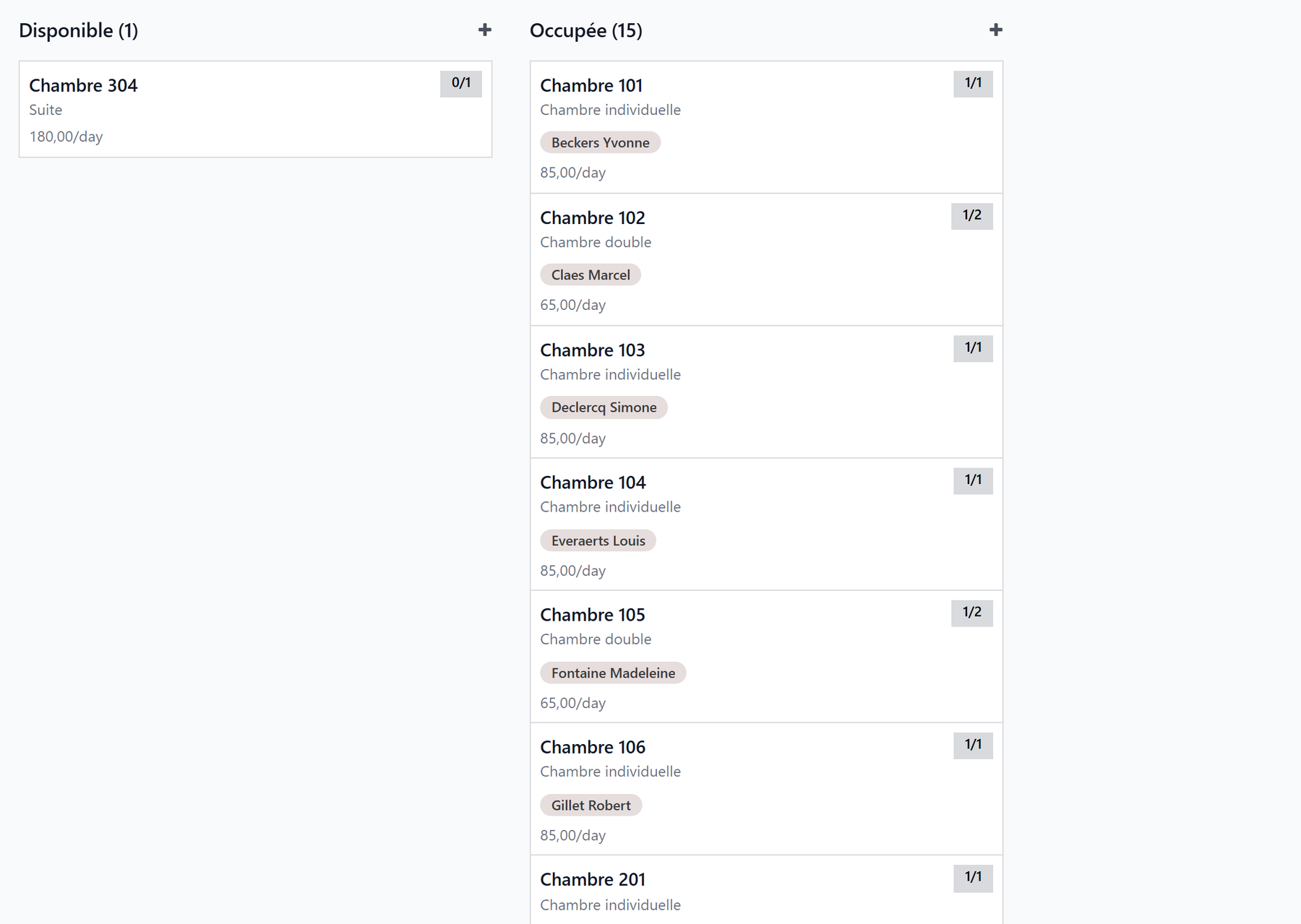
On opening, the rooms are shown as a kanban, grouped by status: Available, Occupied, Under Maintenance and Reserved. At a glance, you can see where space remains.
Each room card shows:
the room number;
an occupancy badge “occupied / capacity” (for example 1/1 or 1/2), coloured by status — green (Available), blue (Occupied), orange (Under Maintenance), cyan (Reserved);
the room type;
the resident(s) present, if any;
the daily accommodation rate.
The occupancy / capacity badge
A capacity-2 room with only one bed taken shows 1/2 and stays Available: there is still a spot. It only switches to Occupied when all beds are taken. A bed counts as taken from the moment its stay is Confirmed, before the resident arrives.
In the top right, switch from the kanban to the list (number, floor, sector, type, capacity, occupancy, planned departure, rate, equipment, status) or the form.
Filtering and grouping
The search bar offers quick filters: Active (not maintenance) — applied on opening —, Available, Occupied, Maintenance, Reserved and Frees up (date known). Group the rooms by State, Floor, Type, Sector or Planned Departure, and search by number, floor, building, sector or planned departure.
Tip
Frees up (date known) answers the question of a waiting list: which rooms free up, and when. See The waiting list.
The room record
Click a card to open the room record. At the top, the status bar shows the current state, and ribbons flag a room as Maintenance or Reserved. The Tasks smart button opens the open tasks of the room (preparation, cleaning) — see Staff tasks.
Field |
Purpose |
|---|---|
Room Number |
Unique identifier of the room. |
Room Type |
Determines the daily rate and the default capacity. |
Floor / Building |
Physical location. |
Sector |
Sector or floor of the facility; used for grouping, the dashboards and access rights. |
Capacity |
Number of beds in the room. |
Current Occupancy |
Number of occupied beds (computed). |
Planned Departure |
The day a bed actually frees up, when a departure or a room change is planned. |
Daily Rate |
Accommodation price, taken from the room type. |
Billing Product |
Product linked to the room type (read-only; the Product smart button opens it). |
The daily rate is not the care allowance
The daily rate is the accommodation price (the room), a value specific to your facility, set on the room type. It is distinct from the care allowance paid by the health insurer, which follows the country’s rules and the resident’s dependency category — not the room.
In Belgium
The care allowance is the INAMI dependency allowance: it is declared with the resident’s Katz category — see The INAMI package. How many days each room and sector was occupied, or empty, over a period is in Occupancy Analysis — see Management reports.
Equipment
The Equipment section lists, as tags, what the room provides (television, private bathroom, medical bed, nurse call…). Additional Equipment Notes adds a free-text detail. The equipment catalogue is the same one the condition report uses.
Current occupancy and history
Three tabs complete the record:
Current Occupancy — the residents present in the room (name, resident code, age).
Stay History — all stays that involved this room, with the resident, the start and end dates, and the status (Draft, Confirmed, Active, Ended, Cancelled).
Notes — free internal notes about the room.
Changing a room’s status
The Available / Occupied status is computed from occupancy. You can, however, force a status from the record header:
Set Maintenance — the room switches to Under Maintenance (works, deep cleaning, breakdown…) and is no longer offered for assignment.
Set Reserved — the room becomes Reserved and drops out of the available rooms.
Set Automatic — cancels the manual override: the status is again computed from occupancy.
Maintenance and Reserved block assignment
As long as a room is Under Maintenance or Reserved, the Assign Resident button is hidden and the room does not appear in the room lists of the admission or the room change. Click Set Automatic to make it assignable again.
graph LR
  A[Available] -->|a resident assigned| B[Occupied]
  B -->|all beds freed| A
  A -->|Set Maintenance| C[Under Maintenance]
  A -->|Set Reserved| D[Reserved]
  C -->|Set Automatic| A
  D -->|Set Automatic| A
Assigning a resident from the room
You can open a stay directly from a free room, without going through the admission pipeline:
Open the record of an Available room (neither full, nor under maintenance, nor reserved — otherwise the button does not appear).
Click Assign Resident.
In the wizard, choose the Resident (only residents are offered).
Check the Admission Date (today by default) and, if needed, the Planned End Date.
The Daily Rate is taken from the room; fill in Invoice To if the invoice must be addressed to a third party (a relative, a public welfare body).
Optionally add an Admission Reason, then click Assign Resident.
WideCare creates the stay on this room, already Active, and brings you back to the room record.
When the resident is already housed: the transfer
If the chosen resident already occupies a room, the wizard shows a Transfer warning naming their current room, and the button becomes Transfer Resident. On confirmation, WideCare ends the old stay (reason: internal transfer) and opens a new stay in the chosen room.
Assign ≠ Change Room
Assigning an already-housed resident from the room performs a simple transfer. For a room change that splits the accommodation billing at the right date, can be scheduled ahead and keeps the care allowance paid by the health insurer continuous, use Change Room on the stay — see Room change and transfer.
Generating the rooms of a new home
On a new database, lay out every room in one go:
Open Nursing Home → Accommodation → Rooms.
Open the gear menu next to the title and choose Generate Rooms.
Fill in:
Building and Number Prefix (optional);
Floors, First Floor and Rooms per Floor;
the Room Type of the rooms;
One Sector per Floor, to create a sector for each floor.
Check the Numbering preview (001, 101, 214…), then click Generate.
Existing room numbers are left untouched: rename or adjust the generated rooms afterwards. Generate Rooms is offered to managers, on a computer screen.
Configuring room types, sectors and equipment
The room structure is prepared in Nursing Home → Configuration → Rooms:
Sectors / Floors — the wings or floors of the house (Name, Code, Color), with their rooms and the number of residents.
Room Types — each type (single, double…) with its Code, its Billing Product, its Daily Rate, its Default Capacity and, for a place used during the day only, Day Place. A room’s rate derives from its type: one type per price.
Room Equipment — the catalogue of equipment (Name, Category: Comfort, Medical, Technology, Outdoor, Other), which you then tick on each room.
The default capacity of a new room is set in the settings — see Configuration.
Key takeaways
The occupancy board lives in Nursing Home → Accommodation → Rooms, as a kanban grouped by status.
A shared room stays Available as long as one bed is free; a bed counts as taken from the Confirmed stay.
Set Maintenance / Set Reserved force a status; Set Automatic restores it.
Frees up (date known) shows the rooms that free up on a known date.
Assign Resident creates an active stay; for an already-housed resident it becomes a transfer.
Generate Rooms lays out a new home in one go.
Going further
Technical interventions — the Interventions button of the room lists its repair tickets.