Setting up a day care centre
A day care centre needs five things before its first user: its approval, its opening days, a day room, the amounts of the CSJ forfait and its own day price. The day room comes with the approval; the four others are yours to enter.
1. Record the CSJ approval
A day care centre has its own INAMI number — one starting with 755 to 758, ending in 000 — and WideCare records it on an establishment of its own, with its eHealth certificate. See eHealth and eFact settings.
Go to Settings → Approvals → Manage establishments and approvals and create the establishment of the day care centre: its name and its INAMI number. WideCare reads the type from the number.
Under its Sectors tab, add a line with CSJ as sector and the number of places it covers under Beds / places (1). The line also shows the users Enrolled and the Day room of the approval.
Open the line: the approval’s own form carries the reference, the date and the opening days below.
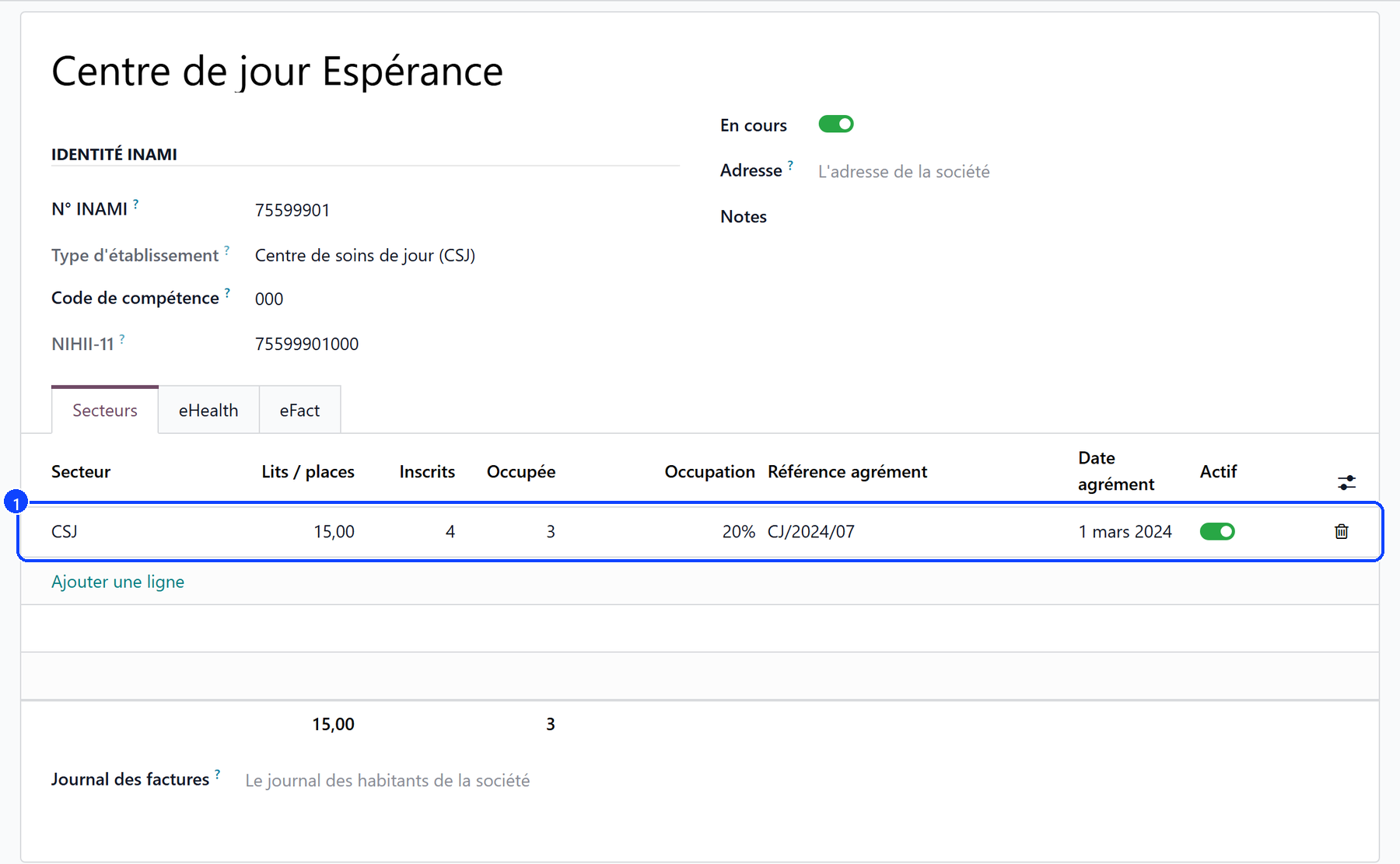
Once the approval exists, Day care centre → Configuration → Approval and opening days opens it straight away.
A house that runs a rest home as well keeps its MR and MRS approvals next to it, on the rest home’s own establishment: an admission is only offered the sectors the house is licensed for.
2. Set the opening days and hours
On the CSJ approval, the Opening days and hours section (2) says when the centre opens: the days from Monday to Sunday, Opens at and Closes at. It starts from Monday to Friday, 8:00 to 18:00 — the legal floor.
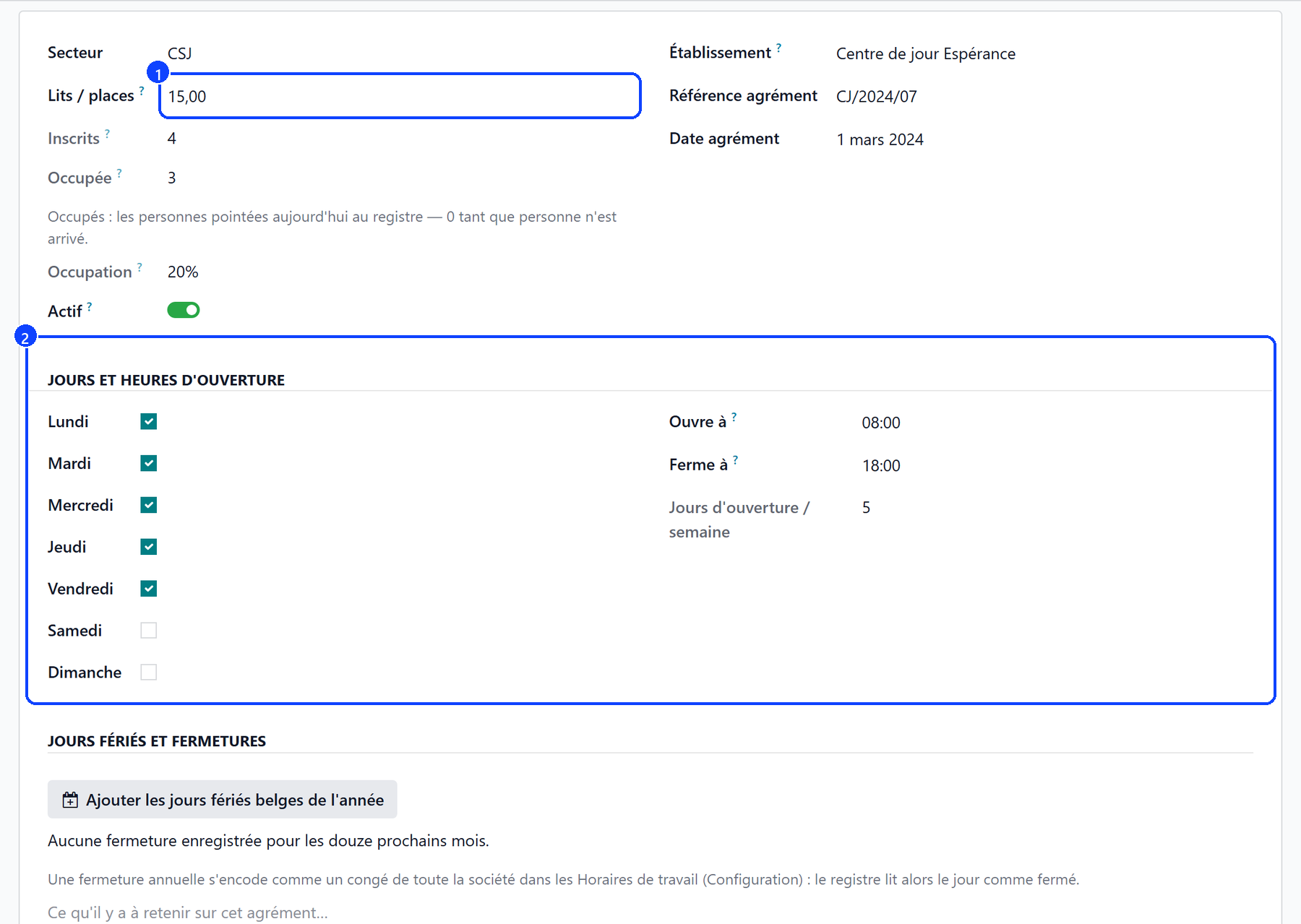
Open Days / Week counts the days ticked.
Under five days a week, or with a window narrower than 8:00–18:00, a banner says the centre is below the norm. It is said, never blocked: what the centre opens is its own to declare.
Enrolled counts the users whose stay is running: more users than places is normal for a day care centre — they do not all come the same day.
Day room is the room the users of this approval are admitted in (see step 3).
Occupied and Occupancy count the users ticked in at today’s register against the places: 0 until someone arrives. More people today than places is said in a banner, never blocked.
These days are read everywhere else: a day recorded in the register on a day the centre is closed is flagged Centre closed that day, and a user with no agreed days is expected on every day the centre opens.
Public holidays and closures
The Public holidays and closures section of the approval says which days the centre shuts, on top of its weekdays:
Add the Belgian public holidays of the year records the ten legal public holidays, from New Year’s Day to Christmas Day, as closures of the whole company. A day already recorded is skipped.
A yearly closure, or any other day the centre shuts, is entered under Day care centre → Configuration → Closures and public holidays: a name, a start and an end, for the whole company.
Below the button, the closures of the next twelve months are listed with their reason.
A public holiday or a closure reads as a day the centre is closed, exactly as a weekday left unticked: nobody is expected, and the screen at the door says The centre is closed today.
3. Check the day room
A day care user holds a day place, never a licensed bed. The CSJ approval brings its own room: recording « CSJ, 15 places » creates the room Day room — (establishment name) with a capacity of 15, of the room type Day care place, in the day care sector. Changing the places of the approval changes the capacity of the room.
A room of the day place type the house already had is taken rather than doubled.
The room type has Day Place ticked (3), under Healthcare → Configuration → Rooms → Room Types: tick it on any type of your own that is a day room.
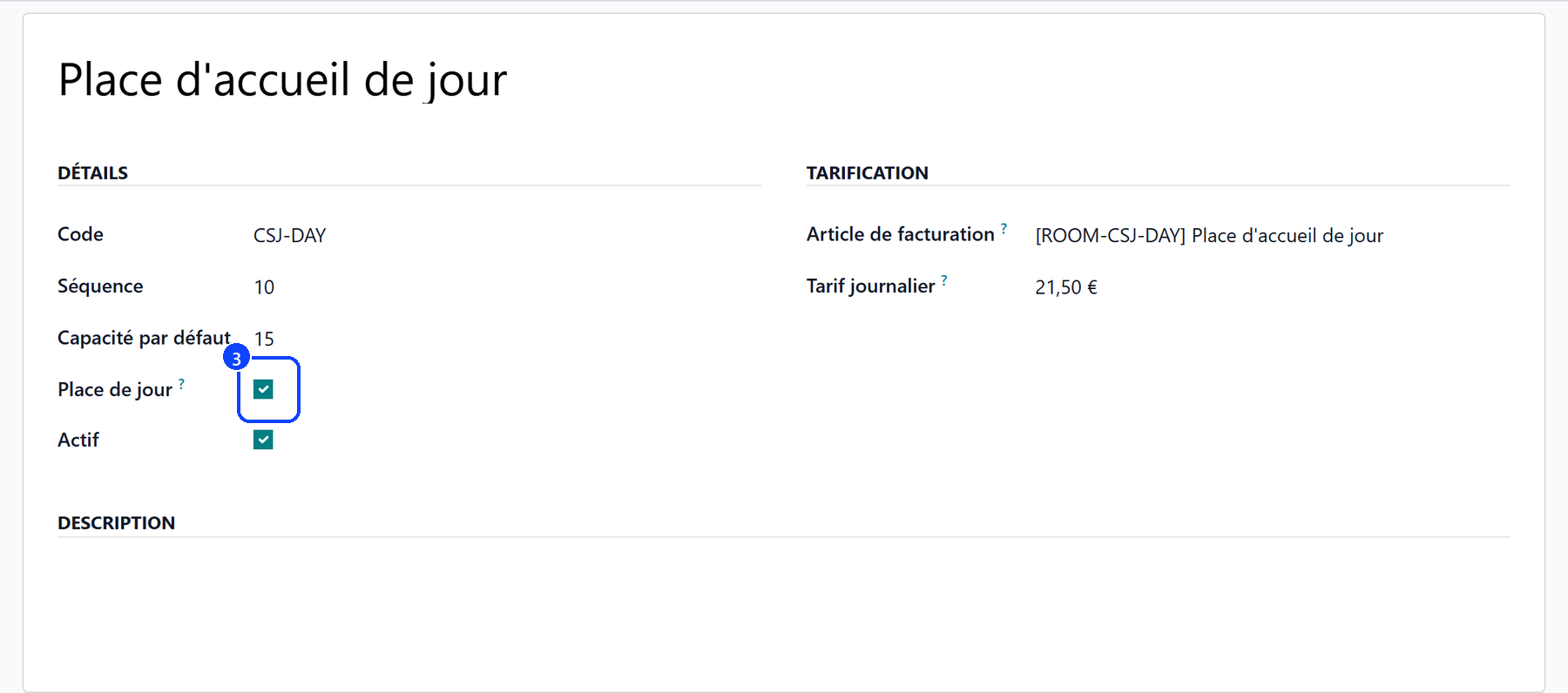
From then on:
a day care stay only goes in a day place, and a residential stay never does;
every room picker offers day places to a day care stay, and beds to the others;
a day room reads « 15 day places » in the pickers, never « free beds »: the places are shared, and a centre enrols more users than it has places.
4. Fill in the CSJ rates
The health insurer pays a daily forfait per CSJ category. Under Billing → Configuration → INAMI Rates, the grid carries one row per CSJ category, each with its own pseudo-code:
Category |
Pseudo-code |
|---|---|
F |
126036 |
Fp |
126073 |
D |
126095 |
Fd |
126117 |
Enter the amount in force from its start date (4). The amount is the same for every category: the category declares the user’s profile to the insurer. The list opens on the rates with No end date; the Day care (CSJ) filter keeps the four rows of the centre, and Currently valid shows the rates in force today.

Warning
A rate left at 0.00 EUR bills no forfait. WideCare never sends a claim at zero: the month’s generation says which users were left without one, and why.
5. Set the centre’s day price
What the user pays is the centre’s day price: the Daily Rate of the day place’s room type, under Healthcare → Configuration → Rooms → Room Types (5).
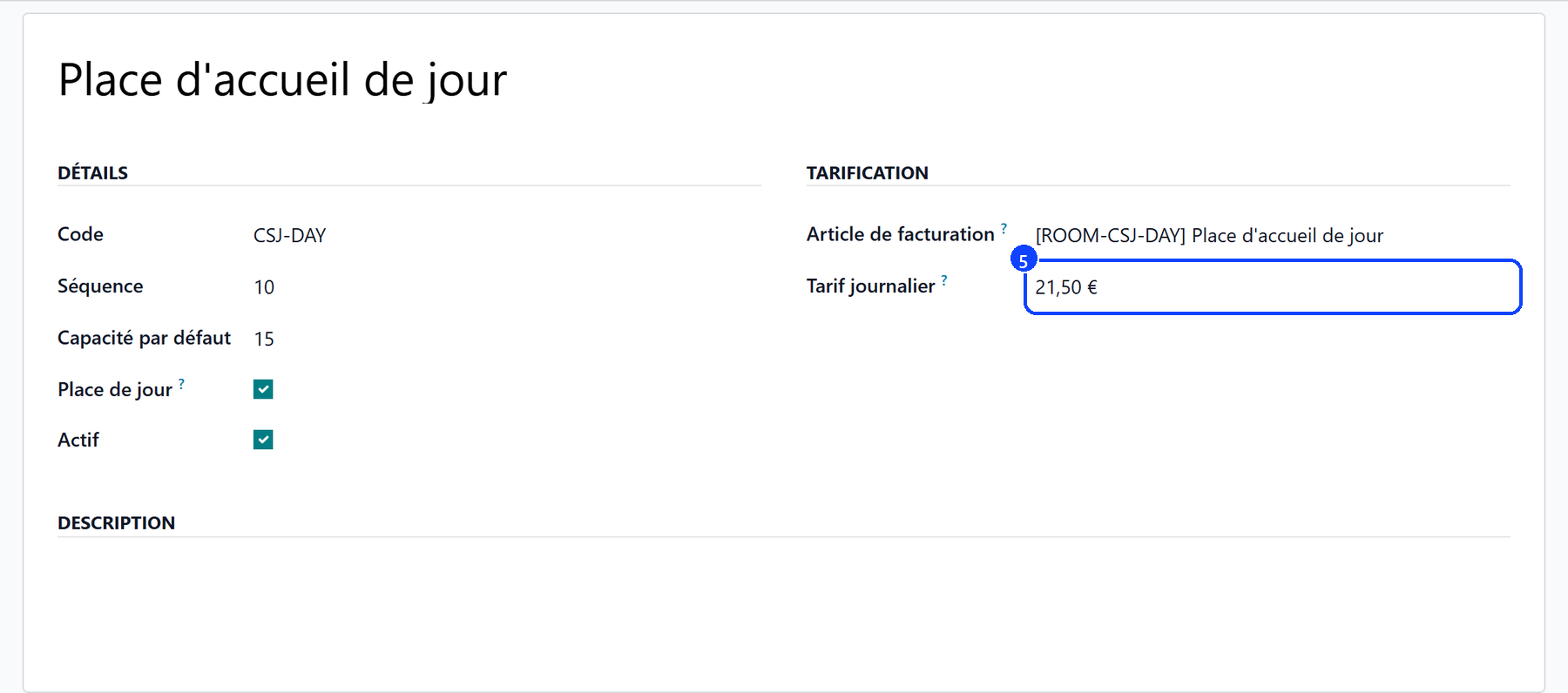
Every day attended is billed at that price, on one line a month with the days attended as its quantity.
Nothing is subscribed at admission: the price follows the place.
A place left at 0.00 EUR bills the user nothing; a note on the user’s file says so when the stay starts.
The transport between home and the centre, and the unannounced absence, are supplements with a price of their own: see Billing a day care month.
Give the team its rights
On each user, under Settings → Users, the Day care rights say who keeps the register and who may amend a closed day:
Keep the register — ticks who came and when, at the door or on the list;
Amend a closed register day — corrects a past day, or an arrival after 13:00, prints the register; every change is logged.
Care assistants and the activity team keep the register; the head nurse, the billing managers and the managers may amend it.
Note
The screen at the door shows the users of the sectors the person is assigned to. When the day care sector is missing from an employee’s file, the screen says how many users it does not show: add the centre’s sector on the employee file.
What’s next
Admitting a day care user — the stay, the days expected, the category, the move-in steps.
Recording attendance — the screen at the door, the register, one day at a time.